

Falcon Geofoam is your source for Elevation Geofoam. With one of the largest EPS Geofoam production facilities in North America, multiple plants, UL certification and competitive pricing there is no reason to look anywhere else for your geotechnical solution!
What is Geofoam?
Elevation Geofoam (or Geo Foam) is not the commodity white foam typically found in your local hardware store, it is a stronger engineered EPS foam for an engineered geotechnical solution. Geofoam is a lightweight, rigid foam plastic (EPS – Expanded Polystyrene) that has been used around the world as a fill for more than 30 years. It is approximately 100 times lighter than most soil. This extreme difference in unit weight compared to other materials makes it an attractive fill material in both transportation and non-transportation applications. EPS geofoam also reduces lateral stress encountered with traditional materials, especially in embankment situations.
Common Geofoam Applications:
- Slope Stabilization
- Soil Stabilization
- Bridge Abutments
- Embankments
- Theater “Stadium” Seating
- Retaining Structures
- Utility Protection
- Pavement Insulation
- Shallow Foundations
- Roadbeds
- Landscaping
Who is Atlas EPS?
Atlas EPS is an “EPS block molder” that has been in business for over 40 years. As a division of Atlas Roofing Corporation, Atlas EPS has great depth of technical resources and a strong financial foundation. Atlas has 3rd party certification for a variety of construction applications, including certification by Underwriters Laboratories to ASTM D6817-07, the recognized industry standard for geofoam applications. With an Engineering Department and separate Quality Assurance Group Atlas EPS can offer you the product solutions you require for any EPS foam application.
Where do we ship?
United States
Alabama (AL), Alaska (AK), Arizona (AZ), Arkansas (AR), California (CA), Colorado (CO), Connecticut (CT), Delaware (DE), District of Columbia (DC), Florida (FL), Georgia (GA), Guam (GU), Hawaii (HI), Idaho (ID), Illinois (IL), Indiana (IN), Iowa (IA), Kansas (KS), Kentucky (KY), Louisiana (LA), Maine (ME), Maryland (MD), Massachusetts (MA), Michigan (MI), Minnesota (MN), Mississippi (MS), Missouri (MO), Montana (MT), Nebraska (NE), Nevada (NV), New Hampshire (NH), New Jersey (NJ), New Mexico (NM), New York (NY)North Carolina (NC), North Dakota (ND), Ohio (OH), Oklahoma (OK), Oregon (OR), Pennyslvania (PA), Rhode Island (RI)South Carolina (SC), South Dakota (SD), Tennessee (TN), Texas (TX), Utah (UT), Vermont (VT), Virginia (VA)Virgin Islands (VI), Washington (WA), West Virginia (WV), Wisconsin (WI), Wyoming (WY)
Canada
Ontario (ON), Quebec (QC)
Mexico
Baja California Sur (BCS)
How much does it cost?
The value chain is petrochemical-based: that means its cost is correlated to the cost of oil. Below is an example of approximate cost of Geofoam compared to cost of oil.
| Approximate Cost Per Cubic Yard (before freight) | ||
| BBL Oil Price | $40 | $140 |
| EPS15 | $40.50 | $50.50 |
| EPS22 | $52.00 | $73.00 |
| EPS29 | $63.00 | $90.00 |
Geofoam Standards/Comparison
| ASTM D 6817-07 | EPS12 | EPS15 | EPS19 | EPS22 | EPS29 | |
| Density minimum | 0.70 lb/ft3 | 0.90 lb/ft3 | 1.15 lb/ft3 | 1.35 lb/ft3 | 1.80 lb/ft3 | — |
| 11.2 kg/m3 | 14.4 kg/m3 | 18.4 kg/m3 | 21.6 kg/m3 | 28.8 kg/m3 | — | |
| Compressive resistance 1% deformation | 2.2 psi | 3.6 psi | 5.8 psi | 7.3 psi | 10.9 psi | — |
| 15 kPa | 25 kPa | 40 kPa | 50 kPa | 75 kPa | — | |
| Flexural strength minimum | 10 psi | 25 psi | 30 psi | 40 psi | 50 psi | — |
| 69 kPa | 172 kPa | 207 kPa | 276 kPa | 345 kPa | — | |
| AASHTO / FHWA (Draft) | EPS40 | EPS50 | EPS70 | EPS100 | ||
| Density minimum | 1.00 lb/ft3 | 1.25 lb/ft3 | 1.50 lb/ft3 | 2.00 lb/ft3 | — | |
| 16.0 kg/m3 | 20.0 kg/m3 | 24.0 kg/m3 | 32.0 kg/m3 | — | ||
| Compressive resistance 1% deformation | 5.8 psi | 7.2 psi | 10.2 psi | 14.5 psi | — | |
| 40 kPa | 50 kPa | 70 kPa | 100 kPa | — | ||
| Flexural strength minimum | 25 psi | 30 psi | 40 psi | 50 psi | — | |
| 172 kPa | 207 kPa | 276 kPa | 345 kPa | — | ||
| ASHTO: American Association of State Highway and Transportation Officials | ||||||
| ASTM: American Society for Testing and Materials | ||||||
| FHWA: Federal Highway Administration | ||||||
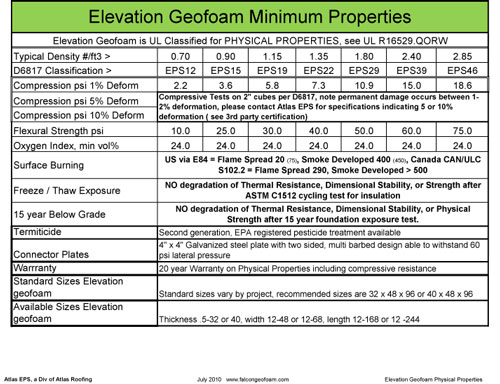
Atlas EPS Typical Properties
Selecting the Right Product Grade
Selecting the correct material for your project is important. If underspecified, the project could fail. If overspecified, money is wasted on extra strength that goes unused. We urge our clients to contract with a civil engineer to help specify the correct grade of product. In general, the engineer will use the dead load of ballast and topping materials, the live load during use (such as traffic), and a safety factor to assure the correct maximum loading is calculated. From this, the load can be converted to pounds per square inch (psi). Then it is simply a matter of selecting the grade from the table that exceeds this psi value at 1% compressive deformation.
Falcon Foam, a division of Atlas Roofing Corporation, has been renamed “Atlas EPS” to reflect its leadership position in delivering innovative, energy-saving solutions and products for the expanded polystyrene (EPS) insulation industry.
Call: 808-545-5252